
How to Check Furniture Finish Quality in Goa: Edge Banding, Joints and Surface
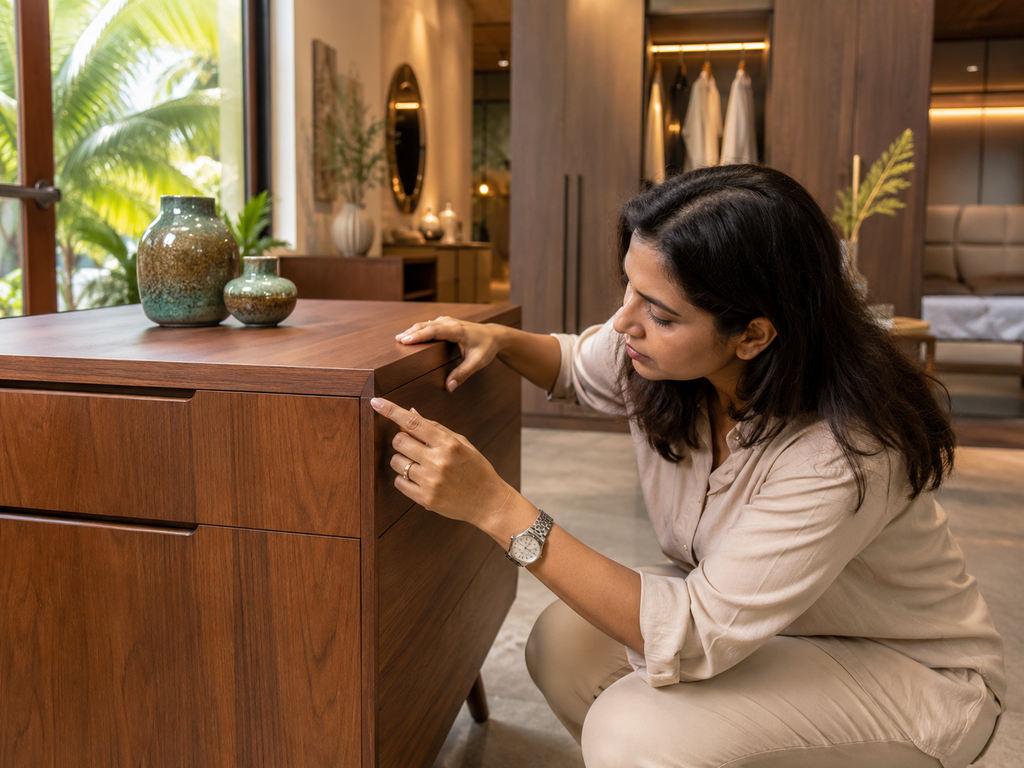
Furniture can look impressive from a distance but reveal quality differences when examined closely. Uneven edges, visible gaps, rough corners, poorly aligned joints, or inconsistent surface finishes may affect both the appearance and everyday experience of the piece.
When buying furniture for a home, villa, apartment, office, or interior project in Goa, it is worth inspecting more than the colour and design. Buyers should look closely at edge banding, surface alignment, internal finishing, joints, corners, drawer gaps, and the transition between materials.
At Brocaade in Goa, homeowners, designers, architects, and project owners can explore premium furniture, custom furniture, sofas, beds, storage units, and complete furniture solutions. Visit the showroom or book a consultation to compare furniture finishes, construction details, materials, and overall quality before ordering.
The direct answer: inspect the edges, joints, gaps and hidden surfaces
To check furniture finish quality, examine the furniture from several angles rather than only from the front. Run your hand gently along the edges, open drawers and shutters, inspect internal surfaces, and look at how separate panels meet.
Check whether:
- Edge bands sit evenly against the panel
- Corners are smooth and consistent
- Joints appear aligned
- Drawers and shutters have balanced gaps
- Surfaces are free from visible bubbles or rough patches
- Veneer or laminate transitions look clean
- Internal sections are finished neatly
- Exposed fixing points are controlled
- The complete piece feels visually balanced
Premium finish quality is often revealed through these smaller details. Buyers comparing quality wooden furniture in Goa should therefore look beyond the visible design and inspect construction, finishing, joints, edges, and overall stability before making a decision.
What is edge banding?
Edge banding is the material applied to exposed panel edges in many types of furniture. It helps cover the inner edge of the board and gives the panel a cleaner, more complete appearance.
Good edge banding should sit securely and consistently along the panel. It should not look uneven, loosely attached, excessively thick, or poorly cut at the corners.
When inspecting edge banding:
- Look for visible gaps between the band and panel.
- Check whether the colour coordinates with the surface.
- Run your hand along the edge to identify roughness.
- Examine corners for uneven cuts or sharp sections.
- Check less-visible areas as well as front-facing edges.
Edge details are particularly important in wardrobes, TV units, study desks, sideboards, bedside units, office furniture, and custom storage.
Examine joints and panel alignment
Joints are the points where separate furniture components meet. Poor alignment can make furniture look uneven even when the material and design are attractive.
Look closely at corners, side panels, shelves, frames, and the points where the top surface meets the body. The sections should appear properly aligned without unnecessary gaps or uneven transitions.
For wooden beds, inspect where the side rails meet the headboard and footboard. For cabinets, check the connection between the top, side, and internal shelves. For custom TV walls or display units, examine how panels and storage sections line up across the full installation.
At Brocaade, buyers can discuss furniture construction and finishing as part of the overall product or custom furniture selection process.
Check drawer and shutter gaps
Drawers and shutters should have consistent spacing. Large differences in gaps can make furniture look poorly aligned and may affect how the unit feels during use.
Stand directly in front of the furniture and check whether:
- Drawer fronts sit at the same level
- Shutters appear balanced
- Gaps are reasonably consistent
- Corners line up properly
- Panels do not appear tilted
- Closed sections sit neatly within the frame
After checking the appearance, open and close each section. Finish quality should be considered alongside furniture hinges, channels and hardware quality, because smooth movement, alignment, and dependable fittings all contribute to how premium furniture performs over time.
Internal link: Furniture Hardware Quality Guide in Goa blog
Inspect the surface under natural and indoor light
Surface quality can look different depending on the light. A finish that appears smooth under showroom lighting may reveal unevenness, scratches, patches, or texture changes when viewed from an angle.
Move around the furniture and observe how light reflects across the surface. Look for:
- Uneven sheen
- Visible scratches
- Bubbles or raised areas
- Rough patches
- Inconsistent colour
- Marks around edges
- Poor transitions between materials
This is useful when examining laminate, veneer, polished wood, painted surfaces, glass elements, or mixed-material furniture.
In Goa homes, natural light can be strong in rooms with large windows or balconies. Buyers should consider how a glossy, matte, textured, or wood-grain finish will look under the actual room conditions.
Check veneer and laminate transitions
Furniture may combine several materials or finishes. A TV unit might use laminate with decorative panels, while a wardrobe may combine a wood-look finish with glass or metal accents.
The transition between these materials should look intentional. Edges should meet cleanly, patterns should not end awkwardly, and decorative sections should remain aligned.
With veneer or wood-grain finishes, check whether the grain direction looks balanced across visible panels. Exact pattern matching may vary depending on the material, but the overall arrangement should not look random or visually distracting.
With laminate, inspect the surface for clean application, edge consistency, and controlled corners.
These details become particularly important when ordering custom furniture solutions in Goa, because made-to-fit wardrobes, TV units, storage, desks, and other pieces often combine multiple panels, finishes, edges, and hardware components.
Do not ignore the internal finish
Buyers often inspect only the outside of furniture. However, the internal finish affects storage use and the overall impression of quality.
Open wardrobes, drawers, cabinets, TV units, bedside units, and storage beds. Check whether the internal surfaces feel reasonably smooth and whether the corners, shelves, and edges appear complete.
Look for:
- Rough internal edges
- Unfinished corners
- Excess adhesive
- Poorly aligned shelves
- Visible damage around fittings
- Uneven internal panels
- Difficult-to-clean areas
The inside does not need to look identical to the outer decorative finish, but it should feel appropriately completed for the furniture’s intended use.
Look closely at corners and exposed edges
Corners experience regular contact during cleaning and daily movement. They should feel smooth and consistent rather than sharp, chipped, or uneven.
This is particularly important for:
- Centre tables
- Bedside units
- Study desks
- Dining furniture
- Low storage cabinets
- Children’s room furniture
- Furniture placed in narrow passages
In compact Goa apartments, exposed corners may sit close to walking routes. Furniture placement and corner design should therefore be considered together.
Furniture finish inspection checklist
| Inspection area | What to check |
|---|---|
| Edge banding | Gaps, roughness, colour and corner finish |
| Joints | Alignment and consistency where panels meet |
| Surfaces | Scratches, bubbles, rough patches and uneven sheen |
| Drawers | Balanced gaps and aligned front panels |
| Shutters | Straight positioning and consistent spacing |
| Corners | Smoothness, chips and exposed rough edges |
| Internal finish | Shelves, storage interiors and hidden edges |
| Material transitions | Clean meeting points between finishes |
| Overall balance | Proportion, symmetry and visual consistency |
Use this checklist in the showroom and again when reviewing custom furniture requirements.
Match the finish to real household use
A finish should suit the room and the way the furniture will be used. High-contact areas may need easier cleaning, while display furniture may prioritise visual detailing.
For homes in Goa, consider sunlight, humidity, ventilation, children, pets, cleaning routines, and the frequency of use. A surface should not be chosen only because it looks premium in a sample.
Brocaade helps buyers compare furniture options based on appearance, materials, room conditions, maintenance expectations, and long-term use.
Common mistakes to avoid
The first mistake is inspecting furniture only from the front. Side, internal, and lower sections also matter.
The second is checking colour without examining alignment and surface consistency.
The third is ignoring drawer and shutter gaps because the hardware appears smooth.
The fourth is choosing a finish from a small sample without considering how it will look across a larger piece.
The fifth is assuming every minor visual variation indicates poor workmanship. Material characteristics can differ, so buyers should ask questions and assess the complete piece rather than relying on one detail alone.
FAQs
How can I check furniture quality in a showroom?
Inspect edges, joints, corners, drawer gaps, shutters, internal storage, and surface consistency. Open and close all usable sections and view the furniture from different angles.
What does poor edge banding look like?
Possible warning signs include visible gaps, rough edges, uneven thickness, sharp corners, or sections that do not sit cleanly against the panel.
Should the inside of furniture have the same finish as the outside?
Not necessarily. Internal and external finishes may differ, but internal areas should still appear neat, usable, and appropriately completed.
Are small gaps around drawers and shutters normal?
Furniture usually requires controlled spacing for movement. The important point is whether the gaps appear balanced and consistent rather than visibly uneven.
Visit Brocaade to compare furniture finish quality in Goa
Premium furniture quality is often found in details that are easy to overlook. Edge banding, joint alignment, surface consistency, internal finishing, and controlled gaps all contribute to how the furniture looks and feels.
For homes, villas, apartments, offices, and interior projects in Goa, Brocaade offers premium furniture, custom furniture solutions in Goa, storage products, and complete setup guidance. Visit Brocaade in Goa or book a consultation to examine furniture materials, finishes, and construction details before making your decision.