
Mattress for Couples in Goa: Motion Transfer, Edge Support & Comfort Guide
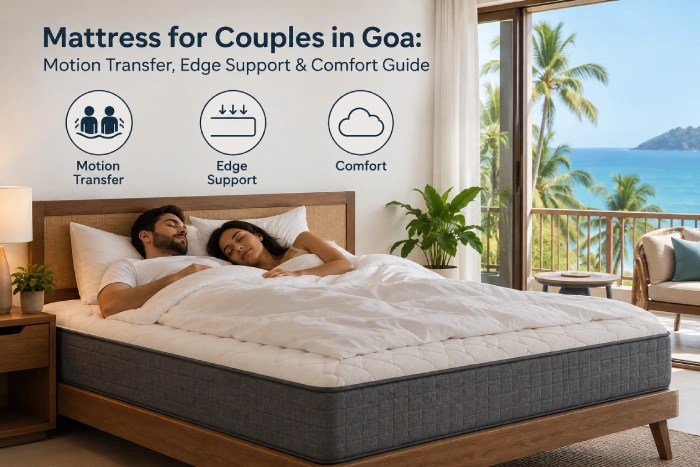
Choosing a mattress as a couple can be more difficult than choosing one for a single sleeper. Two people may have different comfort preferences, sleeping positions, body weights, movement patterns, and ideas about how soft or supportive the mattress should feel.
This means the best mattress for couples is not simply the largest or most expensive option. It should give both people enough usable space, limit unnecessary disturbance when one person moves, feel supportive near the edges, and work with the bed frame and final bed height.
At Brocaade in Goa, couples can compare mattresses, beds, and bedroom furniture while testing comfort together. If you are choosing a mattress for a master bedroom, visit the showroom or book a consultation so both partners can compare mattress feel, size, edge support, movement, and overall bedroom compatibility before buying.
The direct answer: couples should choose a mattress together
A mattress for two people should work for both users, not only the person who makes the purchase decision.
When comparing mattresses, couples should check:
- Mattress size
- Motion transfer
- Edge support
- Comfort feel
- Ease of changing position
- Usable sleeping area
- Bed-frame compatibility
- Final bed height
- Individual sleeping preferences
The best result usually comes from testing the mattress together rather than relying only on specifications.
Why motion transfer matters for couples
Motion transfer refers to how much movement from one side of the mattress can be felt on the other side.
If one person changes sleeping position frequently, gets out of bed earlier, or returns to bed later, excessive movement across the mattress may disturb the other sleeper.
Different mattress constructions handle movement differently. Some materials absorb more movement, while others feel more responsive. However, this should not be judged only by a product category name.
The actual mattress design, comfort layers, support system, firmness, and construction all influence the final feel.
At Brocaade, couples can compare mattresses in person and test what happens when one partner moves while the other remains still.
Do not judge movement only by sitting on the mattress
A quick showroom test can be misleading.
Couples should lie on the mattress in their normal sleeping positions. One person can then turn, sit up, or get off the bed while the other notices how much movement reaches their side.
Try:
- Turning from side to side
- Sitting near the edge
- Getting out of bed
- Returning to the mattress
- Changing sleeping position
- Moving closer to the centre
The goal is not to eliminate every sensation of movement. It is to find a mattress where both partners feel comfortable with the level of disturbance.
Edge support affects usable sleeping space
Edge support describes how stable the mattress feels near its perimeter.
This can matter more for couples because two people use a larger portion of the mattress surface. If the edges feel excessively soft or unstable, both users may naturally move closer to the centre, reducing the amount of comfortable sleeping space.
Good edge feel can also make it easier to sit on the side of the bed while getting dressed, putting on footwear, or standing up.
When testing edge support:
- Sit near the side of the mattress.
- Notice how much the edge compresses.
- Lie closer to the perimeter.
- Check whether you still feel comfortably supported.
- Compare the edge with the centre of the mattress.
Do not assume that a thicker mattress automatically has stronger edge support. The construction matters more than thickness alone.
Mattress size matters when two people share the bed
Even a comfortable mattress can feel restrictive if the bed size does not provide enough space for both users.
A queen-size mattress can suit many couples, while a king-size mattress provides more width where the bedroom has enough space. The right option depends on room dimensions, bed-frame size, walking clearance, bedside furniture, and personal space preferences.
Before selecting a mattress, check:
| Buying factor | What couples should consider |
| Mattress width | Enough personal sleeping space for both users |
| Bedroom size | Bed should not restrict walking or wardrobe access |
| Bed frame | Must correctly support the chosen mattress size |
| Bedside units | Enough space on both sides where required |
| Movement | Larger usable space can help reduce crowding |
| Final height | Both users should be comfortable getting in and out |
The existing Brocaade King Size vs Queen Size Beds guide can help buyers compare bedroom space requirements in more detail.
What if one person likes a softer mattress and the other prefers firmer support?
This is one of the most common challenges when couples shop for a mattress.
The solution is usually not to choose the extreme preference of either person. Instead, both partners should test a range of comfort levels and identify a compromise that feels acceptable for regular use.
Pay attention to:
- How the mattress feels under the shoulders and hips
- Whether each person can change position comfortably
- Whether either person feels they sink too deeply
- Whether the mattress feels excessively rigid
- Whether both users remain comfortable after several minutes
The earlier Brocaade Firm vs Plush Mattress guide can help explain the difference between comfort feel and support.
Couples should avoid assuming that one firmness level is universally better for a particular sleeping position or body type. Personal comfort varies.
Construction type can influence the shared sleeping experience
Memory foam, pocket spring, and other mattress constructions can feel different when shared by two people.
Memory foam may provide a more contouring feel and can help limit some movement transfer depending on the design. Pocket spring mattresses can provide a more responsive feel because individual springs move independently.
However, construction type alone does not determine whether a mattress is suitable for a couple.
Comfort layers, firmness, edge construction, mattress dimensions, and personal preference all matter.
If you are comparing these two mattress types, Brocaade’s Memory Foam vs Pocket Spring Mattress guide provides a more detailed breakdown.
Consider different body weights without relying on simple rules
Two partners may place different loads on the mattress. This can affect how firm or soft the same surface feels to each person.
A mattress that feels relatively firm to one partner may feel softer to another.
This is another reason couples should test together.
Instead of trying to choose a mattress based on a universal body-weight rule, focus on whether both people:
- Feel adequately supported
- Can move comfortably
- Have enough sleeping space
- Find the mattress surface comfortable
- Feel stable near the edges
The aim is shared comfort, not matching a generic chart.
Match the mattress to the bed frame
A couple’s mattress should also fit the bed correctly.
Check the mattress dimensions against the usable bed-frame area, especially when using storage beds, upholstered frames, or beds with raised side rails.
Mattress thickness affects the final bed height, while frame height affects how easy it is for each partner to sit down and stand up.
If one partner is much taller or shorter than the other, both should test the finished bed height.
At Brocaade in Goa, beds and mattresses can be considered together so couples can assess the complete setup rather than buying each item separately.
Think about bedroom layout as well as mattress comfort
Couples need access to the room as well as comfortable sleeping space.
Before buying a larger mattress and bed, measure:
- Wardrobe clearance
- Door swing
- Walking space
- Bedside-unit area
- Window access
- Balcony access
- Dressing or study furniture
- Space at the foot of the bed
A bigger bed is not an upgrade if it makes the room difficult to use.
Common mistakes couples should avoid
The first mistake is allowing only one partner to test the mattress.
The second is choosing mattress size without measuring the bedroom.
The third is focusing only on firmness while ignoring movement and edge feel.
The fourth is choosing by mattress technology alone without testing the actual product.
The fifth is assuming that a thicker or heavier mattress is automatically more comfortable.
FAQs
What mattress is best for couples?
There is no single best mattress for every couple. The right option depends on comfort preference, mattress size, motion transfer, edge support, construction, and how both partners feel when testing it.
Is motion isolation important for couples?
It can be important when one partner moves frequently or follows a different sleep schedule. Couples should test how much movement they feel across the mattress before buying.
Is a king-size mattress better for couples than a queen?
A king-size mattress provides more width, but it requires more bedroom space. A queen can work well where the room is more compact. The better option depends on both sleeping space and room layout.
Should couples test a mattress together?
Yes. Testing together helps both partners assess comfort, movement, edge support, sleeping space, and overall compatibility before making a decision.
Visit Brocaade to compare mattresses for couples in Goa
A mattress shared by two people needs to balance more than firmness. Motion transfer, edge support, usable sleeping space, mattress size, bed compatibility, and two different comfort preferences all influence the final choice.
For master bedrooms, apartments, villas, and premium homes in Goa, Brocaade offers mattresses, beds, and bedroom furniture guidance focused on practical comfort and informed buying. Visit Brocaade in Goa or book a consultation so both partners can compare mattress options together before making a shared decision.