
Plywood vs MDF vs Particle Board in Goa: Custom Furniture Materials Guide
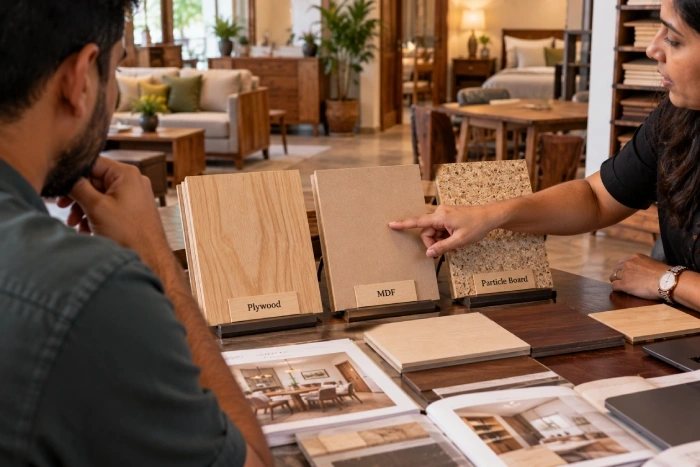
When ordering custom furniture, buyers often hear terms such as plywood, MDF, and particle board without being told exactly what they mean. This can make material selection confusing, especially when one material is casually described as “better” than another without considering the furniture design, intended use, finish, hardware, or construction.
Plywood, MDF, and particle board are different engineered wood products. Each has different characteristics, and material suitability depends on much more than the name printed on a quotation.
At Brocaade in Goa, homeowners and project buyers can discuss custom furniture requirements alongside materials, finishes, storage needs, dimensions, and hardware. If you are planning wardrobes, TV furniture, storage units, study furniture, dining storage, or another custom piece, ask what board is being proposed and why it suits that particular application before approving the design.
The direct answer: there is no single best board for every piece of furniture
Plywood, MDF, and particle board can all be used in furniture, but they are manufactured differently and can behave differently depending on grade, thickness, construction, finish, hardware, exposure, and intended use.
A useful buying decision should therefore consider:
- What the furniture will be used for
- How the unit is constructed
- The board grade and specification
- Surface finish
- Edge treatment
- Hardware
- Expected storage requirements
- Room conditions
- Maintenance
- Quality of workmanship
Choosing furniture only because someone says “this is plywood” or “this is MDF” gives an incomplete picture. When planning custom furniture solutions in Goa, buyers should consider the board material together with the furniture’s dimensions, construction, finish, storage requirements, hardware and intended everyday use.
Plywood vs MDF vs particle board: quick comparison
| Material | Basic construction | Common buying consideration |
| Plywood | Multiple thin wood veneers bonded in layers | Grade, thickness, finish, edge treatment and construction |
| MDF | Wood fibres combined into a dense, uniform panel | Smooth surfaces, detailing, edge finishing and intended use |
| Particle board | Wood particles bonded and pressed into panels | Board specification, edge treatment, hardware and application |
These are broad material categories. Products within each category can differ significantly, so buyers should ask about the actual specification being offered.
What is plywood?
Plywood is manufactured by bonding multiple thin layers of wood veneer together. The direction of the layers is arranged to create a panel rather than a single solid piece of timber.
It is widely used in furniture and interior applications, but the word “plywood” alone does not identify the quality or suitability of a particular board.
Different plywood products can vary in:
- Grade
- Thickness
- Veneer quality
- Adhesive system
- Surface finish
- Intended application
When plywood is proposed for custom furniture, ask what specification is being used and how the exposed edges, surfaces, joints, and hardware will be finished.
Avoid assuming that every plywood product has identical performance or that plywood automatically makes the complete piece of furniture superior.
What is MDF?
MDF, or medium-density fibreboard, is an engineered panel produced from wood fibres that are processed and bonded into a relatively smooth, uniform board.
One characteristic buyers often notice is its consistent surface. This can make MDF useful for furniture designs involving smooth painted finishes, routed patterns, or other forms of detailed surface treatment, depending on the specific board and application.
However, MDF should not simply be labelled “good” or “bad.”
Buyers should consider:
- Board specification
- Thickness
- Furniture location
- Intended load and use
- Edge finishing
- Surface treatment
- Hardware fixing
- Construction method
The suitability of MDF for a particular custom unit should be considered as part of the complete furniture design.
What is particle board?
Particle board is manufactured from wood particles that are combined with binders and pressed into panel form.
It is used in many types of furniture and interior products. As with plywood and MDF, particle board is a broad category rather than one universal specification.
Its performance in furniture depends on factors such as:
- Board quality and density
- Thickness
- Edge treatment
- Surface finish
- Hardware selection
- Joint construction
- Furniture design
- Intended use
It is therefore too simplistic to assume that all particle-board furniture is automatically low quality.
Instead, buyers should look at how the entire piece is designed and constructed.
Do not choose custom furniture by board name alone
The board is only one part of the finished product.
Consider two storage units made from the same general board category. They could still differ considerably because one may use more appropriate thicknesses, better edge finishing, better hardware placement, better joints, or a design better suited to what will be stored.
For that reason, custom furniture buyers should ask:
- What board is being used?
- What grade or specification is proposed?
- What thickness is planned in important sections?
- How will exposed edges be finished?
- What hardware will be fitted?
- How will shelves be supported?
- How is the unit designed for its intended contents?
- What surface finish is being applied?
At Brocaade, custom furniture discussions can consider the material together with dimensions, finishes, storage requirements, and hardware rather than treating the board name as the only quality indicator.
Think about the furniture application
Different furniture pieces place different demands on materials.
A TV console, wardrobe shutter, study desk, crockery unit, drawer, shelf, and decorative panel do not necessarily need identical construction.
The questions should therefore change according to the furniture.
For a wardrobe, buyers may need to consider shutter dimensions, internal shelves, drawers, hardware, and long-term everyday use.
For a dining sideboard, shelf arrangement, drawer use, crockery storage, and surface requirements become important.
For a study unit, desk span, equipment, storage, cable access, and the desired finish may influence the design.
Material selection should follow the furniture requirement rather than applying one material rule to the entire home.
What about Goa’s humidity?
Humidity, ventilation, sunlight, room conditions, maintenance, and exposure should all be considered when selecting furniture for Goa homes.
However, broad claims such as “MDF cannot be used in Goa” or “plywood is completely waterproof” should be avoided.
Performance depends on the specific board, grade, surface and edge treatment, furniture construction, exposure conditions, workmanship, and maintenance.
f a furniture unit will be placed in an area with particular moisture or exposure concerns, discuss those conditions before the material is finalised. Brocaade’s guide to choosing furniture materials for Goa homes provides additional guidance on how humidity, moisture, sunlight and Goa’s coastal conditions can influence furniture-material decisions.
Look at edge finishing and hardware too
Board interiors are often hidden once furniture is complete, but edges and hardware remain important parts of everyday use.
Inspect:
- Edge banding or other edge treatment
- Corners
- Joints
- Hinge fixing
- Drawer channels
- Handles
- Shelf supports
- Shutter alignment
A material cannot compensate for poor detailing elsewhere.
Brocaade’s furniture hardware and finish-quality guides can help buyers understand these additional areas when evaluating custom furniture.
Questions to ask before approving custom furniture
Before finalising an order, ask:
- What board material is proposed?
- What grade and thickness are being used?
- Why does this material suit this piece?
- What finish will cover the surface?
- How will edges be treated?
- What hardware is planned?
- Are different materials being used in different parts?
- What maintenance does the finished furniture require?
Good custom-furniture planning should make these decisions understandable rather than relying only on material labels.
FAQs
Is plywood always better than MDF?
No. Suitability depends on the board specification, furniture design, intended use, finish, construction, hardware, exposure, and other factors.
Is particle board always low quality?
No. Particle board exists in different specifications, and overall furniture quality also depends on construction, edge finishing, hardware, design, and intended use.
Can MDF be used for custom furniture?
MDF can be used in furniture applications depending on the design, board specification, finish, location, and intended use. Buyers should evaluate the complete furniture requirement.
What should I ask a furniture supplier about materials?
Ask what material, grade, thickness, surface finish, edge treatment, and hardware are being proposed and why they suit the intended furniture.
Discuss custom furniture materials with Brocaade in Goa
Plywood, MDF, and particle board should not be reduced to a simple ranking of best to worst. The more useful question is whether the chosen material, grade, construction, finish, hardware, and design are appropriate for the furniture being ordered.
For custom furniture in apartments, villas, homes, offices, and projects in Goa, Brocaade can help buyers consider material options alongside dimensions, storage requirements, finishes, and everyday use. Visit Brocaade in Goa or book a consultation to discuss your custom furniture requirements before approving the final material and design.